DRAGONN Kneeling Chair Review: The Chair That Rolls Fully Under the Desk
The DRAGONN by VIVO kneeling chair has no back and no arms, so it disappears under a desk. What it costs your shins, where it falls short and who it suits.
Why a kneeling chair makes sense in a small room
Most of the space a desk chair takes up is not the seat. It is the backrest and arms that stop it sliding under the desk, so the chair spends its evenings parked halfway into the room.
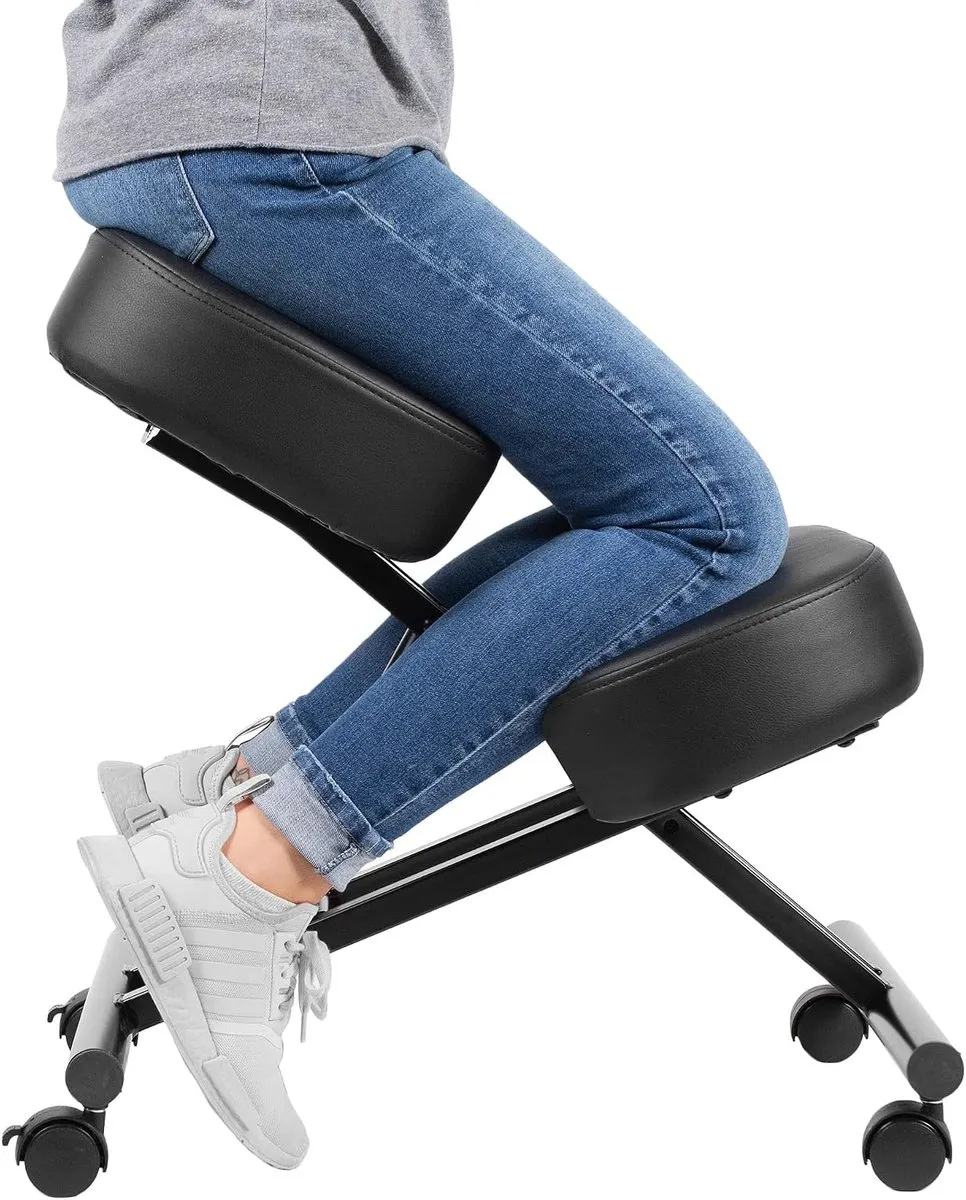
A kneeling chair has neither. The DRAGONN is an X-shaped steel frame on four casters with two pads: a sloping seat for your bottom and a lower pad for your shins. Set at a sensible height, the whole thing rolls under a normal desk and out of the walkway.
It is made by VIVO, the American desk-accessory brand, and sold through VIVO's own Amazon store for around £60. It has been on sale for years and has close to 5,000 ratings averaging 3.7 stars. That average is lower than most chairs we cover, and the reasons are worth understanding before you buy.
Recommended retailer Check the DRAGONN kneeling chair on AmazonPrice and stock shown by retailer. Opens in a new tab. Check current priceThe dimensions that matter
- Footprint: 66.5cm deep by 47.5cm wide
- Height: adjustable over a listed range of roughly 53cm to 79cm
- Seat pad: about 41 x 30cm
- Knee pad: about 45 x 25cm
- Padding: around 7.5cm thick on both pads
- Weight: 8.3kg
- Maximum user weight: 113kg
- Warranty: one year
The 47.5cm width is the useful number. A typical five-star office chair base is 60cm or more across, so this is easier to fit between a bed and a desk or into a narrow alcove.
The 66.5cm depth is less dramatic, because the frame has to reach forward for your shins. The difference is that the depth goes under the desk rather than behind it. On a desk with 60cm or more of clear legroom, almost all of it disappears. On a 40cm-deep desk like the ODK 80 x 40cm, about 25cm will still stick out when it's parked, which is still far less than a normal chair.
Height is the other check. At the lower end of its range, the seat clears the underside of a standard 72cm to 76cm desk comfortably. Wind it towards the top and it won't go under at all. Taller users who need a high setting should measure the gap under their desk before assuming it will tuck away.
What kneeling actually feels like to use
The idea is that the forward-sloping seat opens the angle at your hips and tips your pelvis forward, so sitting upright takes less effort than on a flat seat. Your shins take some of your weight, which is what lets the seat slope without you sliding off.
That shin load is the catch. The owners who are happiest with it tend to use it in bursts, stand up regularly, or swap between this and a normal chair during the day. One larger owner, who uses it daily, describes needing to take the weight off at least every half hour. VIVO's own instructions say the same thing more politely: build up gradually and switch positions.
There is also nothing to lean back against. For typing and focused work that's fine, and some people find it keeps them more upright. For reading, calls or thinking time, you'll miss a backrest quickly.
A couple of owners with back problems describe it as the only seat they could tolerate during a bad spell, which is a real use case. But that's individual, and anyone with knee problems or circulation issues in the lower legs should think carefully about a chair that loads the shins.
The covers and the foam
The build complaints are about the pads rather than the frame.
The first is the cover material. It is a faux leather finish, and more than one owner says it gets warm and sweaty, especially on bare knees or in summer. One notes that sweaty skin on a sloping pad means you slide and have to keep repositioning. In a small, warm bedroom, that matters more than it sounds.
The second is the seat foam. The padding is thick and comfortable when new, but one detailed review describes the seat cushion flattening quickly until the edge of the metal plate underneath becomes noticeable, with the cover held on by staples. It isn't the majority experience, but it is the part of the chair where the £60 price is most likely to show.
Assembly, on the other hand, gets good marks. It's a few bolts, four casters and a height knob, and one owner reports building it alone in under ten minutes with an electric screwdriver.
Who should buy it
Buy the DRAGONN if:
- the chair has to vanish completely when the desk isn't in use
- you want a second, more upright seat to alternate with a normal chair
- your sessions are short, or you get up regularly anyway
- you work at a dining table where a chair with arms won't tuck in
Buy something else if:
- this will be your only chair for full-time desk work
- you have knee or lower-leg problems
- you like to lean back while you work
If full-time comfort matters more than parked space, a conventional chair with flip-up arms is the safer compromise. The Blisswood flip-up chair costs about half as much and still tucks under most desks once the arms are raised, and the Sihoo M57 is the step up for long days.
How it compares
Against the Varier Variable Balans (around £380 on Amazon), the Varier is the original Scandinavian design, with a rocking wooden base instead of casters. It's the one to choose if you like the kneeling idea and want something that looks like furniture. It's also more than six times the price and has no wheels to roll it under the desk.
Against cheaper unbranded kneeling stools, several are available from under £50. Few have anything like the DRAGONN's review history, so it's harder to know how their foam and frames hold up.
Against the HOMCOM cross-legged chair (around £56), the HOMCOM is also armless, but its 65cm-wide seat is much bigger. It suits people who want to sit cross-legged. The DRAGONN is the better choice if footprint is the priority.
DRAGONN kneeling chair verdict
As a small-space chair, the DRAGONN does something almost nothing else at this price does: it gets completely out of the way. At around £60, it's a sensible buy as a second seat, a dining-table chair or a desk chair for shorter sessions.
It's less convincing as the only chair in a full-time home office. The shin pressure limits how long most people use it, the covers get sweaty, and the seat foam is the weak point. Go in expecting a useful, compact alternative rather than an ergonomic cure-all and it makes sense.
Where to go next
Continue from this article into the most relevant compact setup guides, reviews, and hubs.
Chair clearance
How Much Space Do You Need Behind a Desk?
Work out how much parked depth a chair that rolls fully under the desk saves.
Read next
Full-day chairs
Best Office Chairs with Flip-Up Arms UK 2026
Conventional chairs that still tuck away, for longer days than a kneeling chair suits.
Read next
Armless chair
HOMCOM Cross-Legged Chair Review
Another armless alternative, with a much wider seat for sitting cross-legged.
Read next
Desk fit
80cm vs 100cm Desk: Which Is Better for a Small Room?
Use the desk-size guide to check whether your chair will have enough room to move.
Read next